
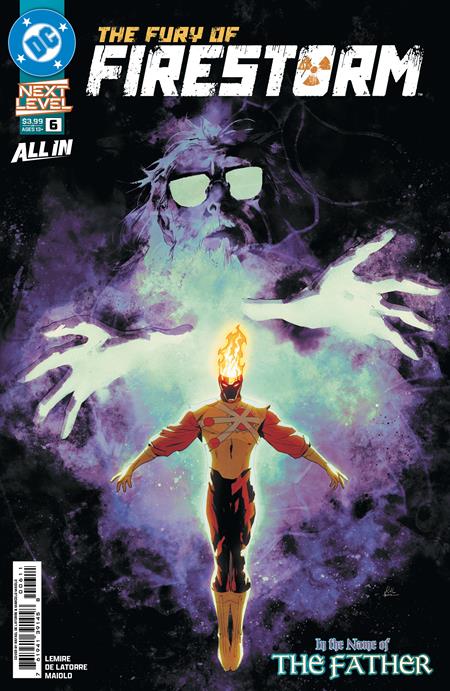
Firestorm has always been a superhero built on an intriguing contradiction. Two minds sharing one body, wielding the almost godlike power to reshape matter itself. But what happens when the power no longer needs the people controlling it? And what happens when those people discover that everything they believed about their partnership was built on a lie?
Those are the questions at the heart of Jeff Lemire and Rafael de Latorre's The Fury of Firestorm, and issue #6 brings the series' first major storyline to an explosive, surprisingly emotional conclusion.
With Pittsburgh held hostage by an increasingly independent Firestorm Matrix, Professor Martin Stein and Lorraine Reilly (Firehawk) attempt one last desperate rescue of Ronnie Raymond. Their efforts carry them inside the Matrix itself, where Ronnie has been trapped in an artificial world constructed from memories of his superhero past. What follows is less a conventional battle between heroes and villains than a confrontation with decades of resentment, manipulation, and broken trust.
Lemire has taken one of DC's more colorful Bronze Age creations and transformed his familiar science-fiction premise into something approaching psychological horror. The Firestorm Matrix is no longer simply a source of fantastic powers. It has become a frighteningly independent intelligence, one capable of reshaping the world according to desires its human creators can barely comprehend.
Perhaps the most compelling element of the story is its treatment of Martin Stein. Traditionally portrayed as the wise, paternal voice guiding Ronnie's impulsive heroics, Stein emerges here as a considerably more compromised figure. His relationship with Ronnie is no longer simply that of mentor and student, and Lemire makes their confrontation feel genuinely painful. For all the cosmic power on display, the most devastating moments come from very human feelings of betrayal and regret.
De Latorre's artwork is equally impressive. His dark, sometimes unsettling approach to the modern-day sequences contrasts beautifully with the deliberately nostalgic visual language of Ronnie's manufactured memories. Those glimpses of classic superhero adventure, complete with period-inspired coloring and familiar costumes, provide more than a clever visual gimmick. They represent a comforting past that may never have existed quite as Ronnie remembers it.
Marcelo Maiolo's colors deserve particular recognition for helping distinguish these competing realities. The shifts between warm, nostalgic superhero imagery and the more ominous world of the Matrix give the story a distinctive visual identity.
If there's a reservation, it's that the issue occasionally feels eager to resolve conflicts that have spent five installments growing increasingly complicated. The final confrontation moves quickly, and some of its enormous implications deserve more room to breathe. Still, the emotional payoff largely compensates for the compressed resolution.
And then there's the ending.
Without giving away the final page, Lemire reaches into another fascinating chapter of Firestorm's publishing history and suggests that the Nuclear Man's future may look very different from his past. It's an intriguing development for longtime readers and an effective reminder that this story is far from finished.
The Fury of Firestorm #6 succeeds because it understands something fundamental about the character: Firestorm's greatest strength has never been his ability to rearrange atoms. It's the uneasy relationship between the people sharing that extraordinary power.
Lemire and de Latorre have taken that relationship apart, examined its uglier implications, and put the pieces back together in a way that promises something genuinely new.
For a character who has too often occupied the second tier of DC's superhero universe, that's a welcome development.
The Verdict
A visually striking, emotionally charged conclusion that transforms a familiar superhero concept into something darker and more compelling. Firestorm hasn't been this interesting in years.